Introduction
The introduction of the lithium-ion battery in the latter half of the 20th century revolutionized battery science by delivering improved energy density, battery life, portability, and higher efficiency (Figure 1). This breakthrough led to a dramatic expansion in the range of applications using batteries, from everyday uses such as consumer electronics to electric vehicles, electric grid storage solutions, medical devices, and defense applications.
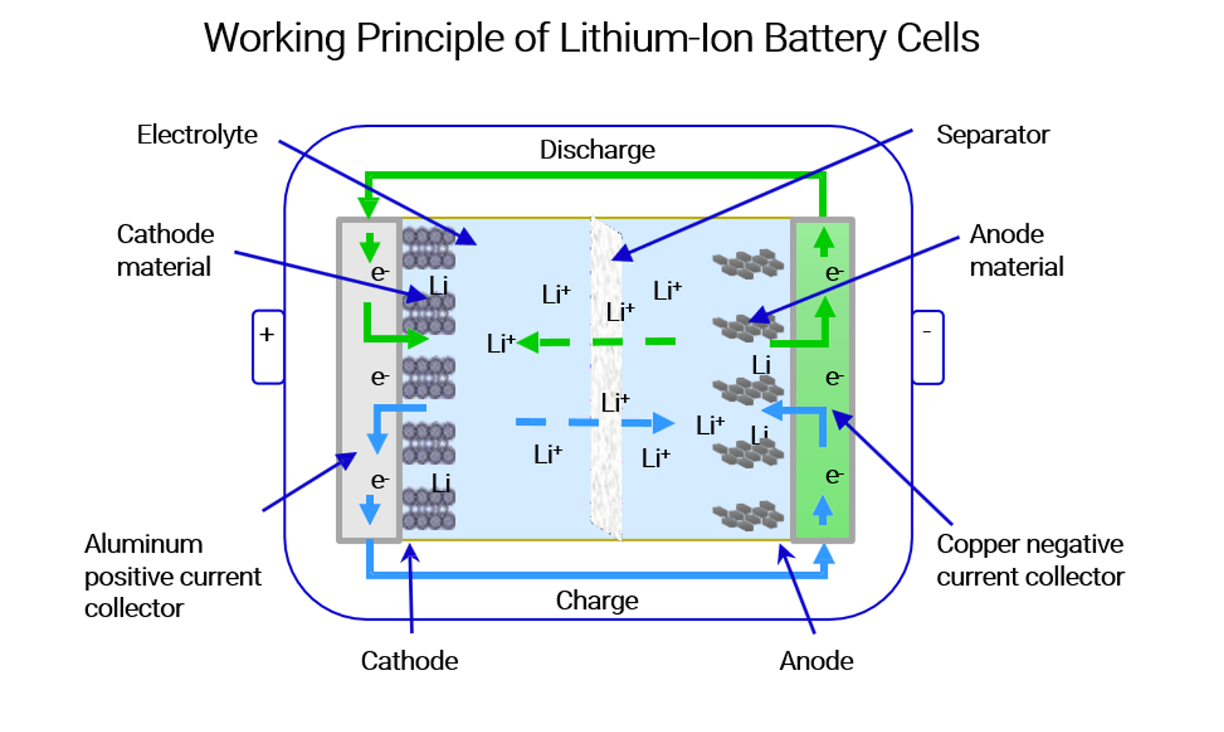
Figure 1. Working principle of a lithium-ion battery cell showing ion and electron flow during charge and discharge, and the roles of cathode, anode, electrolyte, and separator.
To further accelerate adoption and broaden application scope,key challenges must be addressed, such as safety, performance, affordability, and sustainability. To deliver on these needs, processes need to be effectively scaled from bench to laboratory to pilot and ultimately to factory scale. Throughout this scaling process, the implementation and maintenance of stringent process controls, including the management of impurities and contaminants, have become increasingly important.
This article delves into the core customer needs of safety, performance, affordability, and sustainability, and provides guidance on some of the more commonly overlooked process controls that are necessary to deliver on these needs.